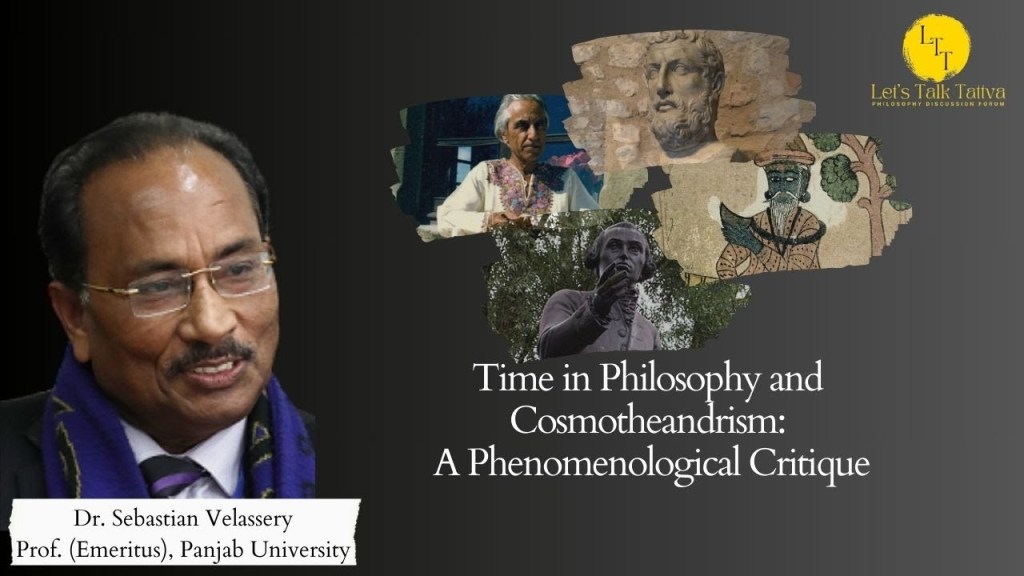
By Prof. Sebastian Velassery | 5 August, 2023
Abstract: There have been predominantly three views concerning the conception of time in Western philosophy. According to the Idealists, time is wholly a figment of imagination. For the idealists, time is nothing but a concept and, therefore, dependent on (human) consciousness. Pythagorean School and members of the Eleatic school expounded the idealist view of time. The idealistic conception of time was rejected primarily because of the reason that if all change and becoming is only apparent, then the whole world around us must be only apparent as well. It was Plato who brought out a compromise on the idealist view by positing a true reality behind ordinary apparent reality. Spinoza and Kant upheld a view of this kind and in our present time, such a view is held by phenomenology, analytical philosophy and philosophy of science. According to the realist view, time is a self-sufficing entity, which is not dependent on anything else. From the relational view, time is a concept and is therefore dependent on consciousness, but at the same time, it is a function of the events happening in nature. The Realists emphasize the idea that there is no time without consciousness, but neither would there be time without events.
If Greeks conceived of time as the life of being, classical India perceived time as the life breath of reality. Hence, Classical Indian philosophers contended that it is time that ‘matures beings and encompasses things’. The most important two works on time that emerged from the religio-philosophical matrices of Indian tradition are one version of Vedānta known as the Grammar philosophy stemming from Bhartṛhari’s Vākyapadīya and the other, the Mādhyamika branch of Buddhism. According to Bhartṛhari, time is the most important power of Brahman, kālaśakti or the power of time is the creative power of kartṛtvaśakti. Thus, Bhartṛhari argues that time is a cooperative cause (sahakārī–kāraṇam) of everything. Summing up, it can be said that time cannot be abstracted from anything because everything, including consciousness, is temporal. To prove the togetherness of eternity and temporality or acrality and secularity, Raymundo Panicker takes recourse to the Advaitic intuition. When Panicker says Advaita, he means that the subject and the object are not two, without being one, that the Divine and Cosmos and/ or the Human are not two, without being the same. The nature of reality is polar, each being constitutive of the whole. Tempiternity, for Panicker, then is the non-dualistic intuition of the non-dual character of reality, which is temporal yet more than temporal. It is eternal. Temporality and eternity are two sides of the same coin. A holistic experience of time would imply the ‘exteriorisation’ of time which would make us cherish our temporality and live the present moment in all its intensity. The interiorization of time is not just a mere acceptance of our temporality; it consists of transcending time. Transcending time does not amount to its negation, rather, it points to the discovery of the other dimension of the temporal aspect of reality. With the possible exception of Parmenides, none of the ancients or medieval philosophers who accepted eternity as a real, atemporal mode of existence denied the reality of time or suggested that all temporal experiences are illusory. In proposing the concept of eternity, such philosophers and Boethius in particular, had introduced two separate modes of real existence. Eternity is a mode of existence, which in Boethius’ view, is neither reducible to time nor incompatible with the reality of time. It is only the discovery of eternity that enables us to make use of words for the duration, words such as permanence and persistence. Eternal life is revealed in time; it may unfold itself in every instant as an eternal present. Eternal life is not a future life, but life in the present. Therefore, it is a mistake to expect eternity as a happening place in the future. Eternity and eternal life are said to be a deliverance from time.
Keywords: Cosmotheandrism, Sahakārī-kāraṇam, Kartṛtva-śakti, Kālaśakti, duree, order of successions, Tempiternity, eternity, holistic experience of time, atemporal, exteriorisation, Interiorization, temporality, transitoriness, Kūṭasthanitya.


 Let's Talk Tattva: A Philosophy Discussion Forum
Leave a comment