by Eckart Frahm
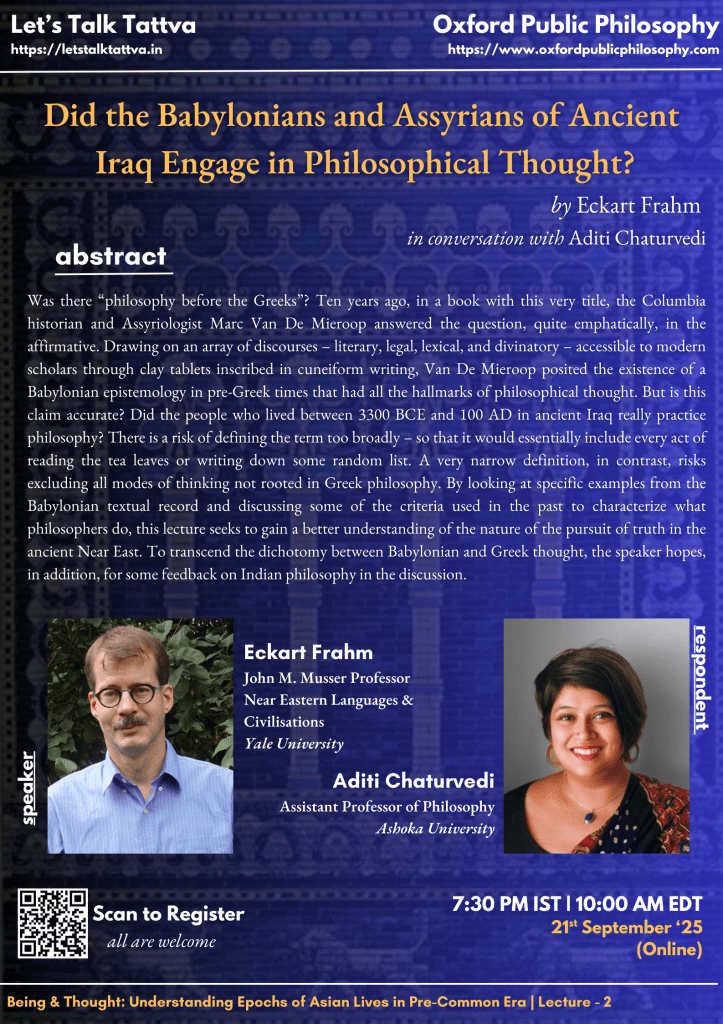
Prof. Eckart Frahm’s lecture is the second of the lecture series — Understanding Epochs of Asian Lives in Pre-Common Era — jointly pursued by Let’s Talk Tattva and Oxford Public Philosophy. Prof. Eckart Frahm, John M. Musser Professor of Near Eastern Languages & Civilizations at Yale University, examines the notion of philosophy in the historical context of ancient Iraq, and asks what it even means to talk about ‘philosophy’ in that context. Prof. Eckart Frahm draws on his historical and philological expertise to analyse several positions on the meaning of philosophy in ancient Babylonia and ancient Assyria. Dr Aditi Chaturvedi, who, thanks to Nishok G U for connecting us with her, joined Prof. Frahm to discuss several questions important to understanding the nature of philosophy in the ancient contexts, such as ancient Greece or ancient Iraq. Dr Aditi Chaturvedi is an Assistant Professor of Philosophy at Ashoka University.
abstract: Was there “philosophy before the Greeks”? Ten years ago, in a book with this very title, the Columbia historian and Assyriologist Marc Van De Mieroop answered the question, quite emphatically, in the affirmative. Drawing on an array of discourses – literary, legal, lexical, and divinatory – accessible to modern scholars through clay tablets inscribed in cuneiform writing, Van De Mieroop posited the existence of a Babylonian epistemology in pre-Greek times that had all the hallmarks of philosophical thought. But is this claim accurate? Did the people who lived between 3300 BCE and 100 AD in ancient Iraq really practice philosophy? There is a risk of defining the term too broadly – so that it would essentially include every act of reading the tea leaves or writing down some random list. A very narrow definition, in contrast, risks excluding all modes of thinking not rooted in Greek philosophy. By looking at specific examples from the Babylonian textual record and discussing some of the criteria used in the past to characterize what philosophers do, this lecture seeks to gain a better understanding of the nature of the pursuit of truth in the ancient Near East. To transcend the dichotomy between Babylonian and Greek thought, the speaker hopes, in addition, for some feedback on Indian philosophy in the discussion.





Leave a Reply